
Sergei Ostrenko
Director • Choreographer • Teacher of Acting and Theatre Directing

Background and Early Career
Sergei Ostrenko is a director, choreographer, and teacher of acting and theatre directing whose professional career in the performing arts spans more than four decades. He began his professional career in 1979 as a stage designer, later continuing his education as an actor and then as a director. [4][5][6] He made his debut as a theatre director in 1986 with a production of Gogol’s The Government Inspector at a professional repertory theatre in Russia. [4][5]
Ostrenko’s formative training is rooted in the methods of Konstantin Stanislavsky, Vsevolod Meyerhold, and Mikhail Chekhov - a foundation that continues to underpin his creative and pedagogical work. [4][5][6] His background in the visual arts has had a lasting influence on his directing, with productions noted for their visual and spatial qualities. As described in an academic chapter in the book Modern Theatre in Russia: Tradition Building and Transmission Processes (Bloomsbury, 2018), the author recounts participating in a 2007 workshop on Stanislavsky’s, Meyerhold’s, and M. Chekhov’s actor training techniques led by Ostrenko at Retzhof Castle in Leitring bei Leibnitz, Austria. [68]
Artistic Approach and the Ostrenko Method
Ostrenko’s creative work integrates the Russian theatre school tradition with contemporary experiments in the performing arts. [4][5] Since the late 1990s, he has travelled extensively to study both traditional and modern performance techniques, including Chinese Opera, Mak Yong, Butoh, the Alexander Technique, Laban movement analysis, Pilates, the Suzuki method, Contact and Structural Improvisation, Kinetic Environment, Viewpoints, the working method of Eugenio Barba, and Meyerhold’s Biomechanics. [4][6]
Over the course of his career, working alongside his brother Gennadiy Ostrenko, Sergei developed a systematic methodology now known as the Ostrenko Method. This approach combines Meyerhold’s Biomechanics, Mikhail Chekhov’s Psychological Gesture, and Stanislavsky’s Physical Action with contemporary improvisation and physical dramaturgy. [5][6] The method centres on the performer’s physicality: through physical actions, actors discover form, emotional expression, and depth of feeling, while their relationship with artistic space and freedom in improvisation play a central role in the creative process. [5][6]
Assistant Professor Dennis Schebetta, Head of MFA Performance Pedagogy at Virginia Commonwealth University, who was awarded a Hewlett grant to attend Ostrenko’s residency in Amelia, Italy, wrote: [64]
“Recently, I participated in a biomechanics and Michael Chekhov intensive with Sergei Ostrenko. I noted that several of the principles conveyed in the training aligned with or complemented the Meisner technique. In this physical theatre training, the idea of ‘physical attention’ and the use of imagination was essential to the development of the actor.” - Dennis Schebetta, Assistant Professor, Virginia Commonwealth University [64]
Schebetta further reflected on the implications of Ostrenko’s approach for ensemble-based theatre: “As devised and ensemble-based theatre become more prominent, I am curious how the Meisner technique might evolve to become a useful tool in developing this type of performance.” He noted that combining ensemble-based methodologies from Ostrenko’s training with Meisner exercises had been “quite effective for students in understanding how they can apply the technique in various ways.” The VCU Global Studies Center newsletter reported that Schebetta’s Hewlett-funded residency in Amelia, Italy, brought together 17 participants from 10 countries “engaging in physical theatre practices derived from Ostrenko’s experience at the Moscow Theatre School, including Meyerhold’s Biomechanics and Michael Chekhov’s gesture work.” [64][109]
Writing in Performance Philosophy and the Irish journal in:Action, Jack Beglin described the Ostrenko brothers’ approach as one that “guides the performers through the development of a physical culture, a form of self-exploration that provides a fully alive, fresh presence on stage.” He observed that their training produced “moving tableaux [that] became embodied statues of the psyche that connected us to a collective unconscious.” Beglin concluded that the Ostrenko brothers and IUGTE are “doing a brave thing - in a world of increasing materialism, they are investing in the technologies of the imagination and the human heart, connecting international performers through the universal language of the moving body.” [97]
Since 1986, Ostrenko has also practised Chen-style Tai Chi Chuan, which has been a consistent element of his personal daily training for nearly four decades. He has integrated principles of Tai Chi into his teaching as a supplementary training method for dancers, choreographers, and actors. [4][6]
Ostrenko is among a small number of practitioners in Europe who specialise in physical theatre through the prism of the Russian theatre school tradition. This positioning is corroborated by multiple independent sources: Portuguese actor and trainer Bruno Schiappa places Ostrenko alongside Eugenio Barba as a continuous influence on his physical theatre practice [45]; Colum Parke Morgan specifically identifies Ostrenko’s training as “GITIS-based” [47]; Dennis Schebetta of Virginia Commonwealth University describes the method as derived from Ostrenko’s experience at the Moscow Theatre School [64][109]; The Scotsman and BroadwayWorld place Ostrenko among “great masters” of European theatre [76][77]; Jack Beglin, writing in Performance Philosophy and in:Action, describes the methodology as unique in its combination of Russian tradition and contemporary physical practice [97]; and the University of Warwick awarded a PhD research grant specifically to study at Ostrenko’s residency. [57]
An international acting school based in Italy teaches the Ostrenko Method as its core curriculum, described as “an international acting school teaching the international acting language through Sergei Ostrenko’s acting method.” [67]


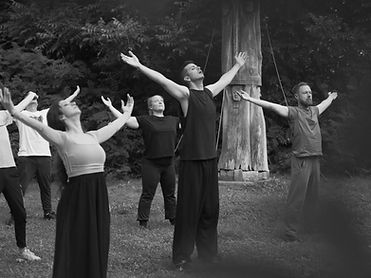
Directing Career
Ostrenko has directed dozens of theatre productions across a range of genres, working with international casts and creative teams in countries including Russia, Ukraine, Belarus, Austria, Italy, Germany, Lithuania, and the United Kingdom, among others. [4][5] His approach is described by collaborators as effective for building ensemble cohesion and creating productions within limited rehearsal periods. [4][7][8]
Stage combat choreography for Odyssey of Captain Blood - Semipalatinsk (now Semey), Kazakhstan, 1990.
Choreographer (balletmaster) at the Russian Drama Theatre of Belarus (now the National Academic Drama Theatre named after Maxim Gorky), Minsk: Christ and Antichrist (Христос и Антихрист), after Dmitry Merezhkovsky's trilogy (1991); Tsarevich Alexei (Царевич Алексей, 1990–1991); and Simpletons of Unexpected Islands (Простачки нежданных островов), after Bernard Shaw (1991). [9][10]


%20%D0%9E%D1%81%D1%82%D1%80%D0%B5%D0%BD%D0%BA%D0%BE%20%D1%80%D0%B5%D0%B6%D0%B8%D1%81%D1%81%D0%B5%D1%80_JPG.jpg)
Trail of the Autumn Full Moon (След осеннего полнолуния) - an original devised performance compiled and directed by Ostrenko, based on texts from various ancient Chinese literary sources (1993, Riga). The piece included philosophical dialogue, among them the Zhuangzi parable of the fish: "Their delight is in their freedom… You are not a fish - how can you know what delights a fish?"
Pink Butterfly (Розовая бабочка) - Tyumen, Siberia, 1998
Original play written by Ostrenko, based on a story from Chinese classical literature. Rehearsals began in March; the production premiered at the end of April 1998. Ostrenko wrote the text during the rehearsal process. The production also featured the song "Northern Wind" (Северный ветер), with music by Viktor Kopytyakov, originally composed for a production Ostrenko had directed in Minsk.


In 2000, he worked as the movement director on The Scapins’ Deceits (Les Fourberies de Scapin) by Molière at the Mikhail Chekhov Russian Drama Theatre in Riga.
IUGTE Anton Chekhov Project - Riga, 2001.
The first IUGTE international project: a three-week course entitled The Actor's Technique, for professional actors and directors, focused on methods of working with actors based on Anton Chekhov's playwriting. Four instructors: Sergei Ostrenko (general artistic direction), Vladimir Scheblikin (Chekhov technique, Moscow), Inna Mitskevich (vocal work), and Andrej Andrianov (movement). Participants came from Finland, Sweden, Norway, the United Kingdom, and Russia. The final work demonstration - comprising fragments from Ivanoff, The Seagull, The Three Sisters, and The Cherry Orchard - was shown on the stage of the Riga Small Theatre.
Choreographer and dancer in a duet performance with Olga Zhitlukhina at the festival Time to Dance (Время танцевать) in Riga (2001). The piece was subsequently performed at a festival in Switzerland.


Theatre Village (Театральная деревня) - an IUGTE international project dedicated to the bicentenary of Nikolai Gogol (2008, Malpils, Latvia). A three-week residency with participants from Switzerland, Australia, Germany, Ireland, Norway, Mexico, Chile, and the Netherlands. The performance included excerpts from Gogol’s Diary of a Madman (performed as a monologue by a Chilean actor) and The Government Inspector, interwoven with folk songs and lullabies from participants’ countries. The performance was multilingual (Spanish, Dutch, Norwegian, English, among others).
Shakespeare Transit - comprising fragments of Hamlet, Othello, and Titus Andronicus - created with an international team of directors from the USA (Artemis Preeshl), Spain (Ferran Utzet), France (Etty Elliot), and China (Li Zinan) at the Donetsk Regional Russian TYuZ (2009). The production received positive critical and audience reception at the Art-Alternative festival-laboratory. [1]


Playing Richard (Играем Ричарда), after Shakespeare’s Richard III, at the Luhansk Academic Russian Drama Theatre (premiere 28–29 September 2012), with co-director Marie de La Guéronnière. The Luhansk theatre’s artistic director wrote that through Ostrenko’s “deepened psychophysical training,” the company was able to “touch the living contemporary European theatre,” and noted the production included a performer trained at Marcel Marceau’s theatre. [11][12][13][14]
Productions at the Anton Chekhov Theatre in Taganrog, including a Romeo and Juliet project (2012) with international participants. Spanish actor Pablo Lechuga, who participated, recalled: “I went to Russia with Sergei Ostrenko, where I learned physical theatre and Meyerhold’s biomechanics, and performed Romeo and Juliet at Anton Chekhov’s theatre in Taganrog.” [23][24][25] Canadian actress Grace Gordon described returning from Russia “where she worked under Biomechanics master and director Sergei Ostrenko at the Saratov State Theatre.” [78]
Boris Godunov - a production based on fragments of Pushkin's Boris Godunov and Schiller's Demetrius, at the Russian Drama Theatre of Lithuania, Vilnius (2013).


Lullaby for Hamlet (Колыбельная для Гамлета), a music-and-theatre piece at the Stavropol Drama Theatre (2014), created by an international team from Italy, Chile, Ukraine, Serbia, and Turkey, with Ostrenko as artistic director. The theatre’s director noted: “The experience that Sergei Ostrenko and his colleagues brought us during the work on Lullaby for Hamlet proved very useful. I was sometimes amazed by our actors, who selflessly rehearsed all day.” [3][15][16][17][18][19][72]
Love and Death in Verona (Любовь и смерть в Вероне), after Shakespeare’s Romeo and Juliet, at the Saratov TYuZ (premiere 15 September 2015). A joint project with Art Universe and IUGTE, with set design by Julia Belle (Italy), choreography and scenography by Gennadiy Ostrenko, and costumes by Olga Kolesnikova. The production featured a movement-based dramaturgical approach incorporating contemporary dance and Meyerhold’s Biomechanics. [2][20][21][22]
Hungarian artist Bence Vági credited film director Katalin Fekete with introducing him to Ostrenko’s work, stating that Ostrenko “acquainted him with the Stanislavsky theatrical methodology” - an encounter that deepened his interest in the theatre culture of Central and Eastern Europe. [23]
Teaching, Research, and International Activity
Since 1988, Ostrenko has taught in the field of professional theatre education, including positions at the Latvian State Conservatory named after Jāzeps Vītols, the Latvian Academy of Culture, and the Latvian branch of GITIS (the Russian Institute of Theatre Arts), the University of Calgary, and the Rosebud School of the Arts in Canada. [4][6] He has led educational courses, master classes, workshops, and laboratories with international groups of directors, choreographers, dancers, actors, and circus performers in countries including the United Kingdom, Denmark, Sweden, Austria, Hungary, Italy, Malta, Canada, the Czech Republic, Slovenia, Latvia, Lithuania, Germany, Kazakhstan, Russia, Belarus, and Ukraine. [4][5]


In 1995, Ostrenko founded the Laboratory of Movement and Dance in Riga - a long-term research project bringing together professional performers, directors, dancers, choreographers, and psychologists to investigate improvisation, spontaneity, ensemble cohesion, and creative processes in the performing arts. [4][26][27] Psychologist Indra Majore (later Majore-Dūšele) was involved in the laboratory’s work, which became a meeting point for professional dancers and psychologists engaged in contact improvisation and dance/movement therapy research. [26]
Work with Psychologists
The Laboratory’s interdisciplinary character - combining performing arts with psychology - had a lasting impact. In a publication from Rīga Stradiņš University, a dance and movement therapy practitioner recounted attending “the creative research laboratory of Indra Majore and Sergei Ostrenko,” which utilised various dance and movement therapy methods. She described the experience as a decisive turning point: “Something clicked — this is what I want to do.” The laboratory helped her transition from conventional psychological counselling toward body-based therapeutic work. [28] The laboratory is also referenced in the Latvian journal Business Psychology in the context of the intersection between performance practice and psychology. [69] Ten years of this work were devoted to dance theatre, and the laboratory is credited with contributing to the development of contemporary dance in the Baltic states and laying practical groundwork for the field of professional dance and movement therapy in Latvia. [4][26][27][28][69]
IUGTE, NIPAI, and International Programmes
Since 2000, Ostrenko has served as the artistic director of Ostrenko Performing Arts Lab (OPAL), an international laboratory for actors and directors operating in the United Kingdom, Austria, and Italy. [4] In the same period, he co-founded the International University Global Theatre Experience (IUGTE), a non-profit organisation dedicated to exploring world performance traditions and promoting the exchange of artistic ideas. [4][5] In 2017, the organisation was rebranded as NIPAI - the New International Performing Arts Institute - where Ostrenko continues as Head of the Theatre Department. [2][5] The organization's mission is to explore and promote performance traditions from around the world and to foster the exchange of artistic ideas in the modern world.
Through NIPAI (formerly IUGTE), Ostrenko has led annual international conferences, physical theatre laboratories, theatre directing diploma and certificate programs, and residency programmes. Venues have included Retzhof Castle in Styria, Austria [68][80]; Massa and Amelia in Italy [58][95][98]; and Malpils in Latvia [36][37]. Since 2018, the International Physical Theatre Laboratory (IPTL) and NIPAI Conference have been hosted at Laubegg Castle in Austria. [99] These programmes have drawn participants from dozens of countries worldwide. [5][30–69]


Students, Influence, and International Impact
Over the course of his teaching career, Ostrenko’s students - theatre practitioners from Russia, Europe, the Americas, Asia, and Australasia - have gone on to apply his creative method in their own directing, choreography, and teaching. [4][5] The breadth of his influence is documented across scores of professional biographies, university publications, press interviews, and academic journals.
Student and Participant Testimonials:
Participants in programs led by Sergei Ostrenko have described his impact in published reviews and professional biographies:
“I have always wanted to perform full-time, to be challenged as an artist… This program was the first experience I have ever had that showed me it is truly possible. During this week of training, I lived the life I have always wanted to live. The life of an artist.” - Sebastian Cummings, Germany, NIPAI reviews [NIPAI]
"...There’s deep philosophy and meaning behind Sergei's teaching and leadership as a director, and I really appreciated different approach in guiding the actors through physical action." - Ji Won Jeon, South Korea, Google Maps reviews [Google Maps]
"I attended a workshop with Sergei and the NIPAI conference and had a wonderful time. Sergei is an incredible teacher and I gained so much inspiration and tangible learnings. I met the most special people and had a beautiful experience." - Eli Pauley, USA, Google Maps reviews [Google Maps]
"I participated in a 5 day Physical theatre Lab with the Ostrenko brothers. I really appreciated the ‘do first, ask later’-approach, giving us the possibility to our own experience. Loved the mix of exercises and the build up to show cases. I am very much inspired by the content of the workshop itself, just as well as the method of teaching." - Nathalie Drakemyr, Switzerland, Google Maps reviews [Google Maps]
"The approach and method of the Ostrenko brothers and their incredible leadership are definitely able to combine a huge amount of techniques with the opportunity to look at our own creation and experience art in a deeper way. I believe that every artist should experience this, what they offer to the world of arts is truly something very special. The opportunity to "try it out before asking questions" also allowed me to access important places to understand what I was truly experiencing with the exercises. Regardless of the level of complexity of the exercises, from the simplest to the most complex, it is possible to take a deep dive into your art and learn every second from what you experience there." - Raisa Ratorraca, Brazil, Google Maps reviews [Google Maps]
"I really enjoy learning and working with Sergei, and his approach is something that every performer should experience." - Bojan Lazarov, Macedonia, Google Maps reviews [Google Maps]
Magdalena Krohn (Poland) wrote in her creative report: “Participating in one of Ostrenko workshops will not only give you new skills but will also help you gain a fresh perspective on your practice. This has genuinely been one of the best experiences of my life.” [NIPAI]
Daisy Badger (United Kingdom) stated in her creative repost: “If anyone has lost touch with their body - or if you’re intrigued by Biomechanics - I would nudge you towards NIPAI IUGTE & Sergei. Great week of physical lab and a top-notch conference!” [NIPAI]
Siu Hei Chung (Hong Kong) reflected: “I learnt how to give clear and brief instructions to actors through the process I was given instructions.” [NIPAI]
Influence on Artists, Directors, and Choreographers:
A Latvian dance ensemble director, interviewed in the Latvian national periodical press, credited Ostrenko with teaching her the principles of composition and structure essential for choreography: “Sergei Ostrenko is my authority — he taught me the connections dancers need to know when creating choreography, and those are the tricks my dancers have already learned too. He is the one who taught me how to put it all together.” [38]
Portuguese actor and trainer Bruno Schiappa, describing his continuous training path, cited “Physical Theater by Eugenio Barba, Thomas Metler and Sergei Ostrenko, who has always accompanied me, leading to new references and crossings of many others.” [45]
Colum Parke Morgan, an international physical theatre practitioner, lists Ostrenko among his mentors alongside Norman Taylor (Lecoq pedagogy), Gennadi Bogdanov (Meyerhold’s Biomechanics), Théâtre de l’Ange Fou (Decroux’s Corporeal Mime), and Antonio Fava (Commedia dell’Arte), describing Ostrenko’s training specifically as “GITIS-based training.” [47]
American artist Jason Ries, known for his interdisciplinary work combining theatre with neon sculpture, describes how training with Ostrenko influenced his artistic vision: having “trained in Latvia and Ukraine with director Sergei Ostrenko,” Ries found “a new way to explore his fascination with different configurations of light distribution, movement and illuminating the architecture of the human body.” [36]
Canadian actress Grace Gordon described Ostrenko specifically as a “Biomechanics master and director” after returning from working with him at the Saratov State Theatre. [78]
Press coverage has placed Ostrenko alongside internationally established figures: The Scotsman and BroadwayWorld described Spanish actor Pablo Lechuga as having “worked with great masters around Europe such as Philippe Gaulier, Sergei Ostrenko, Gytis Padegimas and Jessica Walker.” [76][77] At Michigan State University, a public programme note on Macedonian artist Bojan Lazarov listed Ostrenko among “important theatre masters and directors, such as Eugenio Barba, Jan Fabre, Fabio Tolledi, and Sergei Ostrenko.” [107]
University and Academic Citations:
Ostrenko’s work has been cited in several academic contexts. In the book Modern Theatre in Russia: Tradition Building and Transmission Processes (Bloomsbury), the author describes first-hand participation in Ostrenko’s 2007 workshop on Stanislavsky’s, Meyerhold’s, and M. Chekhov’s techniques at Retzhof Castle, Austria. [68]
Eleanor Chadwick, a PhD student in the Department of Theatre and Performance Studies at the University of Warwick (United Kingdom), was awarded a competitive grant to attend the IUGTE Arts Oasis International Residency led by Ostrenko — an indication of the academic community’s recognition of the programme’s research value for advanced study in performance practice. [57]
Dennis Schebetta, Assistant Professor and Head of MFA Performance Pedagogy at Virginia Commonwealth University (USA), received a Hewlett grant to attend Ostrenko’s arts residency in Amelia, Italy, with 17 participants from 10 countries. The VCU Global Studies Center Newsletter reported that participants engaged in “physical theatre practices derived from Ostrenko’s experience at the Moscow Theatre School, including Meyerhold’s Biomechanics and Michael Chekhov’s gesture work.” In his published academic article, Schebetta described integrating principles from Ostrenko’s training into his own MFA pedagogy. [64][109]
Martin A. David, artistic director of a US theatre-dance project and alumnus of Brooklyn College, participated in Ostrenko’s Physical Theatre Laboratory in Latvia. His experience was documented in the Brooklyn College alumni magazine, demonstrating the reach of Ostrenko’s programmes into US higher education networks. [39]
Patrick Stayer, a senior theatre major at the Johnny Carson School of Theatre and Film, University of Nebraska–Lincoln, received both an ArtUniverse scholarship and a grant from his school to attend the International Physical Theatre Conference and Laboratory in Carrara, Italy. The university’s newsroom featured his experience training under Ostrenko, noting the programme’s combination of intensive physical work with international collaborative practice. [40]
Shahrin, a graduate of LASALLE College of the Arts (Singapore), attended the International Choreographer’s Workshop organised by IUGTE in Massa, Italy, led by Ostrenko — supported by a capability grant from the National Arts Council of Singapore, reflecting the institutional recognition of the programme’s professional value. [63][108]
A trainee at the Fabbrica dell’Opera di Roma (the young artists programme of the Teatro dell’Opera di Roma) also lists Ostrenko in their professional training. [83]
The journal SEEP (Slavic and East European Performance), a peer-reviewed publication in the field of Eastern European theatre studies, also references Ostrenko’s work. [71]
Publications in the German-Speaking World:
The Austrian publication Zeitschrift Menschen, a magazine focused on social inclusion and cultural participation, featured an article about Ostrenko’s work in its coverage of arts and performance practice in Austria. [81] The Retzhof Magazin, published by the Retzhof conference centre in Styria, Austria, documented Ostrenko’s projects hosted at the venue over multiple years. [80] Ostrenko’s work was also covered by the Swedish newspaper Ystads Allehanda. [91]
Broader International Reach:
Among the many practitioners from around the world who cite training with Ostrenko in their professional biographies are theatre artists from Australia [1][30], Austria [54][56][89][100], Canada [34][78], Chile [95], the Czech Republic [94], Germany [66], Greece [35], Hungary [23], Ireland [50][97], Italy [46][62][83][86][90][98][99], Latvia [26][28][31], Macedonia and Slovenia [44][65][106][107], Mexico [59], Poland[84], Portugal [45], Russia [32][48], Singapore [63][108], Spain [25][61][76][77][103], Switzerland [60], Turkey [87], Ukraine [52][53][55], the United Kingdom [43][51][85], and the United States [33][36][39][40][49][64][88][93][109], among other countries.
Ostrenko’s work and artistic philosophy have been the subject of press conferences [41], published interviews [74][75], festival documentation [70][72][73][81][91], and newspaper features across Russia, Ukraine, Belarus, and internationally. [1][2][3][7][8][15][16][17][18][19][95][96] Video materials documenting his productions and workshops are available on the Art Universe Agency channel. [102]
Sources & Citations
[1] Donetsk TYuZ (Makeyevka) theatre history page: https://donramt.ru/sveden/history/ Documents 2008–2009 collaborations with IUGTE, master classes, and Shakespeare Transit production.
[2] Article: Romeo and Juliet in Saratov TYuZ: https://riasar.ru/news/item/34484-romeo-i-dzhuletta-predstanut-v-sovremennykh... Details the 2015 production; describes Ostrenko as Head of Russian Theatre Department at IUGTE.
[3] Belarus newspaper: traditions of experiment: https://www.sb.by/articles/traditsii-eksperimenta.html Quote from theatre director about Ostrenko’s methods during Lullaby for Hamlet.
[4] Current NIPAI biography page (Russian text): https://www.nipai.org/sergei-ostrenko Primary biographical source. Career timeline, countries, techniques, philosophy.
[5] NIPAI faculty / Physicality in Acting pages: https://www.physicalityinacting.com/about/teachers/sergei-ostrenko English-language details: career start 1979, directing debut 1986, IUGTE founding 2000.
[6] Latvian theatre festival document: https://www.theatre.lv/files/aktualit/faili/TEATRA%20METODIKAS%2004.pdf Latvian-language biography confirming teaching since 1986 (Tai Chi), 1995 (Laboratory), and 2000 (IUGTE).
[7] Stavropol KP article on Ostrenko brothers’ production: https://www.stav.kp.ru/daily/26284.4/3161761/ Reports on the Ostrenko brothers’ method at Stavropol Drama Theatre.
[8] Israeli Culture interview (Bence Vági): https://www.israelculture.info/obnazhennyj-kloun-shou-kotoroe-pridumal-bens-v... Vági credits Ostrenko with introducing him to Stanislavsky methodology.
[9] Russian Drama Theatre of Belarus (1991 record): https://www.rustheatre.by/theatre/history/1291-show.html Ostrenko as balletmaster with Boris Lutsenko, 1991.
[10] Russian Drama Theatre of Belarus (second record): https://www.rustheatre.by/theatre/history/751-show.html Corroborates 1991 collaboration.
[11] Znaniye Rossii: Luhansk Drama Theatre: https://znanierussia.ru/articles/... 2012: Playing Richard, dir. Sergei Ostrenko.
[12] Luhansk Drama Theatre official page: https://lordt.at.ua/index/0-4 Playing Richard, premiere 28–29 September, dir. Ostrenko (London, UK).
[13] Wiki article: Luhansk Academic Drama Theatre: https://wp.wiki-wiki.ru/wp/index.php/... Corroborates 2012 production.
[14] Samlib essay by P. Morozov: https://samlib.ru/m/morozow_p/vzlet.shtml Describes ‘deepened psychophysical training’ and Marcel Marceau connection.
[15] Stavropol Pravda: Shakespeare production: https://www.stapravda.ru/20140411/... Reports on Lullaby for Hamlet.
[16] Stavropol Bezformata article: https://stavropol.bezformata.com/listnews/chto-spektakl-budet-sobitiem/24395267/ Full article on the Stavropol production.
[17] Stavropol Pravda: premiere: https://stapravda.ru/20140927/... Reports on production joining the repertoire.
[18] Minsk News article: https://minsknews.by/k-nam-edet-teatr-v-kotorom-u-mihaila-gorbacheva-byilo-sv... Stavropol won grant; Ostrenko (UK) as artistic director with international team.
[19] City Guide: Stavropol theatre season: https://citygu.ru/itogi-teatralnogo-sezona.html/ Reports on Ostrenko-directed production.
[20] Olga Kolesnikova portfolio: https://olgakolesnikova.art/theatre/ Love and Death in Verona, 15 Sept 2015, set designer Julia Belle, dir. Ostrenko.
[21] Saratov Bezformata: https://saratov.bezformata.com/listnews/tyuz-poedet-s-gastrolyami-v-krim/3761... Confirms Love and Death in Verona as 2015 premiere.
[22] Lisa Gubernii: Saratov TYuZ project: http://lizagubernii.ru/news/34905/... Reports on the international collaboration.
[23] Israeli Culture interview (Bence Vági): https://www.israelculture.info/obnazhennyj-kloun-shou-kotoroe-pridumal-bens-v... Vági credits Ostrenko with Stanislavsky methodology introduction.
[24] Eva Mann portfolio: https://www.evamann.ch/spiel Productions at Taganrog under Ostrenko’s artistic direction.
[25] Pablo Lechuga biography: https://pablolechuga.com/ “I went to Russia with Sergei Ostrenko, learned physical theatre and Meyerhold’s biomechanics.”
[26] Portalcris / VDU academic source: https://portalcris.vdu.lt/server/api/core/bitstreams/f80b368b-c310-407f-9513-... Founding of Laboratory (1995), involvement of Indra Majore, dance/movement therapy research.
[27] Text archive: laboratory record: https://textarchive.ru/c-2532656-pall.html S. Ostrenko’s experimental laboratorium, 1995–1997.
[28] RSU academic publication: https://dspace.rsu.lv/server/api/core/bitstreams/168fd25a-cad2-41fb-b649-7e63... Psychologist’s memoir: ‘creative research laboratory of Indra Majore and Sergei Ostrenko.’
[29] Yalta theatre festival: https://muzteatr.net/iii-mezhdunarodnyj-festival-teatralnogo-iskusstva-teatr-... ‘Rehearsing Chekhov’ master class with Accademia Armata Brancaleone and Ostrenko.
[30] Kim Parkhill CV (Australia): https://www.nowactors.com.au/content/cv/kim-parkhill/now-actors-kim-parkhill-... 2007–2008 IUGTE programmes with Ostrenko in Latvia.
[31] Sanita Duka (Latvia): https://theater-school.com/279-sanita-duka-latvia ‘Educated under... Sergey Ostrenko (IUGTE).’
[32] Anton Gopko: https://msotlt.ru/uchastniki/%D0%B3%D0%BE%D0%BF%D0%BA%D0%BE-%D0%B0%D0%BD%D1%8... Ostrenko student.
[33] David Radamés Toro: https://www.dtorodirects.com/about-1 IPTL with Ostrenko, IUGTE, Malpils, Latvia, 2009.
[34] Kim (Halifax, Canada): https://dapopoberlinproject.blogspot.com/2008/11/whos-who.html Trained under Ostrenko in IUGTE Performers Village, Latvia.
[35] Mayra Stergiou (Greece): https://www.mayrastergiou.com/about-1 2008 Directing, Sergey Ostrenko, Latvia.
[36] Jason Ries (USA): https://www.monkeyhouselovesme.com/jason-ries.html ‘Trained in Latvia and Ukraine with director Sergei Ostrenko.’
[37] Russian Bazaar interview: https://russian-bazaar.com/ru/content/931.htm Singer mentions studying movement with ‘choreographer Sergei Ostrenko.’
[38] Latvian dance magazine: https://dom.lndb.lv/data/obj/file/321064.pdf Choreographer credits Ostrenko with teaching composition principles.
[39] Brooklyn College magazine: https://www.brooklyn.edu/wp-content/uploads/MAG-S2008.pdf Martin A. David at Ostrenko’s Physical Theatre Laboratory.
[40] UNL Newsroom: Patrick Stayer: https://newsroom.unl.edu/announce/artsatunl/3968/22519 UNL student received scholarship to train with Ostrenko in Italy.
[41] Taganrog press conference: https://www.taganrogcity.com/pr_iugte_taganrog_october_2012.html Press conference with Ostrenko.
[42] Kinolift profile (student): https://kinolift.com/ru/42281 Ostrenko student.
[43] Sara Bishop Jones (English Theatre, Germany): https://english-theatre.de/cast-huck-finn/ 2019 IUGTE Conference Physical Theatre Workshop with Ostrenko.
[44] Bojan Lazarov (Macedonia/Slovenia): https://bojanlazarov.wixsite.com/portfolio/about-me Workshops with Eugenio Barba, Jan Fabre, Fabio Tolledi, Sergei Ostrenko.
[45] Bruno Schiappa / CeTeatro (Portugal): https://ceteatro.pt/en/oficina-sobre-o-metodo-do-ator-2022-2/ ‘Physical Theater by Eugenio Barba, Thomas Metler and Sergei Ostrenko.’
[46] Luca Serra (Italy): https://italian-actors.filmmakers.eu/en/actors/luca-serra Ostrenko student.
[47] Colum Parke Morgan: https://colum.info/about-me ‘Sergei Ostrenko (GITIS-based training)’ among mentors.
[48] Olga Kitaeva (Primorsky Mariinsky Theatre): https://prim.mariinsky.ru/en/company/persons/choreographers/olga_kitaeva/ ArtUniversity scholarship, IUGTE Lab with Ostrenko, Austria, 2014.
[49] Adam (SAFD member, USA): https://www.safd.org/MemberProfile/Details/31231 Lists Ostrenko among artists he worked with.
[50] Sinéad Bolger (Ireland): https://www.linkedin.com/in/sinead-bolger-facilitator/ Ostrenko student.
[51] Erin Carr (UK): https://www.erincarr.com/theatre-artist Ostrenko student.
[52] Natalia Ladyko: https://www.natalialadyko.com/movement-artist.html Ostrenko student.
[53] Zoya Baranovska (Ukraine): https://www.aktorky-ta-aktory.org/en/actors/zoya-baranovska ‘2006: Physical action by Sergei Ostrenko.’
[54] Sophia Hahn (Austria): https://sophiahahn.com/wp-content/uploads/SophiaHahn_Portfolio_281024.pdf 2019 Physicality in Acting workshop.
[55] Xueni Yang: https://www.xueniyang.com/choreography Ostrenko student.
[56] Elias Austaller (Austria): https://www.theaterinderkulturfabrik.at/elias-austaller/ ‘Physicality in Acting (Sergei Ostrenko).’ Works at Theater an der Wien.
[57] Eleanor Chadwick (Warwick University): https://warwick.ac.uk/fac/arts/scapvc/theatre/news-and-events/?newsItem=094d4... PhD student awarded grant for IUGTE Arts Oasis Residency with Ostrenko.
[58] Jeff Directs: director training, Massa, Italy: http://www.jeffdirects.com/news/director-training-program-in-massa-italy Report on Ostrenko’s training programme.
[59] Renata Wimer and Sergio Solis (Mexico): https://www.noox.mx/rsdnart-muhlberg Both cite work with Ostrenko; Solis: 2013 International Lab in Vilnius.
[60] Marco Cupellari (Italy/Switzerland): https://lespassionnesdureve.com/wp-content/uploads/2021/09/DP-SCROOGE-Web.pdf Lists workshops with Gaulier, Ostrenko, Julia Varley.
[61] Ferran Utzet (Spain): https://www.teatrelliure.com/sites/default/files/imce/documents/temp2324/doss... Catalan director, Premi Butaca winner, lists training with Ostrenko.
[62] Erbamil company (Italy): https://www.erbamil.it/la-compagnia/ Vittorio Di Mauro lists Ostrenko among training influences.
[63] Shahrin / Maya Dance Theatre (Singapore): https://drlib.lasalle.edu.sg/378/34/MDT_KA_A5ProgBooklet_Design_20160108.pdf International Choreographer’s Workshop by IUGTE in Italy, led by Ostrenko.
[64] Dennis Schebetta (VCU, USA): https://theatrepractice.us/pdfs/Schebetta%20More%20Than%20Repetition.pdf Biomechanics and Chekhov intensive with Ostrenko; Hewlett grant for Amelia residency.
[65] Tin Grabnar (Slovenia): https://www.lg-mb.si/f/docs/predstave/Predlogi-za-pripravo_Pirat-in-luna.pdf Workshops with Fabre, Ostrenko, Frljić, and others.
[66] Tuan Dodge (Germany): https://www.crew-united.com/de/Tuan-Dodge_387207.html 2024 NIPAI workshops with Ostrenko in Berlin.
[67] Acting school in Italy (Ostrenko method): https://www.acting-school-stop.com/acting-schools-italy/ ‘International acting school teaching through Sergei Ostrenko’s acting method.’
[68] Modern Theatre in Russia (Bloomsbury book): https://dokumen.pub/modern-theatre-in-russia-tradition-building-and-transmiss... Author describes 2007 workshop with Ostrenko at Retzhof Castle, Austria.
[69] Latvian business psychology journal: https://biznesapsihologija.lv/wp-content/uploads/2018/09/BP23.pdf References Ostrenko in the context of performance practice and psychology.
[70] Voopiik-Don article: https://voopiik-don.ru/main/2009-06-01-10-47-17/42-2009-06-01-07-03-39/2336-l... Article about Ostrenko’s work.
[71] SEEP journal: https://ru.scribd.com/document/230479553/SEEP-Vol-31-Nn-2-Fall-2011 References Ostrenko.
[72] Literaturnaya Gazeta: Hamlet for Everyone: https://lgz.ru/article/gamlet-dlya-kazhdogo/ Article about an Ostrenko production.
[73] cxid.info article: https://cxid.info/100405.html Article about an Ostrenko production.
[74] RIA Saratov interview: https://riasar.ru/news/item/34865-sergej-ostrenko-my-zhdem-novoj-teatralnoj-r... Interview: ‘We await a new theatre revolution in Russia.’
[75] Strast 10 journal interview: https://strast10.ru/fr/data/nomera/178/2015.178.8-178.pdf Interview with Ostrenko.
[76] The Scotsman (Edinburgh Fringe): https://www.scotsman.com/arts-and-culture/edinburgh-festivals/virtual-royal-m... Lechuga ‘worked with great masters’ including Ostrenko.
[77] BroadwayWorld (Edinburgh Fringe): https://www.broadwayworld.com/scotland/article/ELEPHANT-IN-THE-ROOM-Comes-to-... Same description listing Ostrenko among ‘great masters.’
[78] Grace Gordon (Canada): https://www.bearandcompany.ca/whos-afraid-of-virginia-woolf.html ‘Worked under Biomechanics master and director Sergei Ostrenko.’
[79] Milenio article (Mexico): https://www.milenio.com/cultura/guadalajara-torreon-ofreceran-taller-teatro-f... Student received IUGTE certification for workshop with Ostrenko in Austria.
[80] Retzhof Magazin (Austria): https://www.retzhof.at/bildungshaus/wp-content/uploads/2019/06/Retzhof-Magazi... Documents Ostrenko projects at Retzhof.
[81] Zeitschrift Menschen (Austria): https://www.zeitschriftmenschen.at/content/view/full/113425 Article about Ostrenko’s work.
[82] Valentina Pakou (Backstage): https://www.backstage.com/u/valentina-pakou/ Ostrenko student.
[83] Fabbrica Opera di Roma: https://www.fabbrica.operaroma.it/persone/3603/ Ostrenko student.
[84] Adrianna Hanslik (Poland): https://batat.at.edu.pl/hanslik-adrianna/ Ostrenko student.
[85] Claire Jenkins CV (UK): https://brennanactingagency.com/CV/ClaireJenkinsCV2024.pdf Ostrenko student.
[86] Giulia Manzini (Italy): https://www.giuliamanzini.it/biografia/ Ostrenko student.
[87] Gonça Gümüşayak (Turkey): https://goncagumusayak.wordpress.com/biography/ 2013 IUGTE scholarship; 2014 programme assistant.
[88] Amy Loui (USA): https://fourcolorthemovie.com/cast-crew/amy-loui/ Ostrenko student.
[89] Maxi Schreier: https://fourstringcompany.com/maxi/ Ostrenko student.
[90] Enrico Bergamasco (Italy): https://www.rbcasting.com/rb/web/enricobergamasco Ostrenko student.
[91] Ystad Allehanda (Sweden): https://www.ystadsallehanda.se/ystad/zin-lit-gastades-av-varldsberomd-regissor/ Article about work with Ostrenko.
[92] BV Gjanakadas (LinkedIn): https://www.linkedin.com/in/bvgjanakadas/ Ostrenko student.
[93] James Wheeler (USA, Backstage): https://www.backstage.com/u/james-wheeler-1/ Ostrenko student.
[94] Alisa Zichuk (Czech Republic): https://actorsmap.cz/herec/alisa-zichuk Ostrenko student.
[95] Teatro a Mil (Chile): https://teatroamil.cl/noticias-2019/se-abren-las-postulaciones-para-residenci... Performing arts residency led by Ostrenko in Italy.
[96] Theatre Alberta eNews (Canada): https://www.theatrealberta.com/eNews/2008/December.html IUGTE competition for directors under Ostrenko in Donetsk.
[97] Jack Beglin article (in:Action / Performance Philosophy): https://inaction.ie/2017/11/02/interntional-university-global-theatre-experie... ‘Embodied statues of the psyche’ — detailed article on the Ostrenko brothers’ method.
[98] Italian actor CV (Scribd): https://ru.scribd.com/document/251525227/Curriculum-Vitae-Europass Workshop on Meyerhold, Chekhov, Stanislavsky methods at Armata Brancaleone, Massa.
[99] NIPAI — IPTL at Laubegg Castle: https://www.nipai.org/directing-acting-dance-programs/international-physical-... Since 2018, IPTL and Conference relocated to Laubegg Castle, Austria.
[100] Theater in der Kulturfabrik press kit (Austria): https://www.theaterinderkulturfabrik.at/wp-content/uploads/2024/06/Pressemapp... Elias Austaller bio corroborating Physicality in Acting with Ostrenko.
[101] Kino-teatr.ru student profile: https://www.kino-teatr.ru/kino/acter/m/post/466740/bio/ Ostrenko student.
[102] Art Universe Agency YouTube channel: https://www.youtube.com/@artuniverseagency/videos Video materials: productions, workshops, and interviews.
[103] Laughing Horse (Edinburgh): https://laughinghorsecomedy.co.uk/editfestedinburgh/performer.asp?PerfID=16385 Pablo Lechuga — Ostrenko student.
[104] Kinolift profile (second student): https://kinolift.com/ru/10526 Ostrenko student.
[105] Eva Mann: inszenierungen: https://www.evamann.ch/inszenierungen Romeo and Juliet at Taganrog, artistic direction Ostrenko.
[106] Biennial of Puppetry Artists of Slovenia: https://www.lg-mb.si/f/docs/biennial-archive/Catalogue-of-the-9th-Biennial-of... Tin Grabnar bio: workshops with Ostrenko.
[107] MSU: Macedonian Cultural Dance Workshop: https://arts.msu.edu/event/macedonian-cultural-dance-workshop-demonstrations/ Bojan Lazarov: ‘important theatre masters and directors, such as Eugenio Barba, Jan Fabre, Fabio Tolledi, and Sergei Ostrenko.’
[108] Dancescapesg: choreographers’ profile (Singapore): https://dancescapesg.weebly.com/choreographers-profile.html Shahrin: IUGTE workshop in Italy led by Ostrenko.
[109] Global Studies Center newsletter (VCU): https://myemail.constantcontact.com/Global-Studies-Center-Fall-2016-Newslette... Schebetta: Hewlett grant, 17 participants from 10 countries, Ostrenko’s Moscow Theatre School experience.
[NIPAI] NIPAI reviews and creative reports: https://www.nipai.org/reviews and https://www.nipai.org/reviews/creative-reports Participant testimonials and reviews of Ostrenko’s programmes.
[Google Maps} NIPAI reviews and creative reports: https://maps.app.goo.gl/cF2cmvWmTA1qHhkU6 Participant testimonials and reviews of Ostrenko’s programmes.