

Theatre Directing Certificate Programme • For Beginners
Learn to Direct for the Stage.
A 12-Month Professional Certificate Programme
Throughout the year, you work on one chosen play and build your Director’s Book step by step: analysis, concept, scene structure, blocking logic, rehearsal plan, and communication with actors and designers.
Study by distance or choose the blended format with in-class sessions in Europe. Taught in English. Open to applicants worldwide.
Weekly time commitment: ~9-10 hours. Can be done alongside your current work.
Programme Fee: €12,000. Partial financial support of up to €3,000 is available for qualified candidates.
Competitive Admission
• Competitive Admission • Since 2000 • Berlin, Germany • Students from 25+ Countries • Distance & Blended Options
Who This Is For
This programme is for people who are standing at the beginning of a directing path - and who already have a serious relationship with theatre.
-
You may be an actor who has started to see the whole production, beyond your own role. You’ve been noticing staging, pacing, ensemble dynamics. You sense there’s a craft here you want to learn - by doing it, with guidance.
-
You may be a performer or choreographer ready to move from physical material into dramatic structure. You understand bodies in space; now you want tools for text, conflict, and scene logic.
-
You may be a teacher who needs directing tools for student productions. You direct as part of your role, and you want formal methodology and a certificate documenting your training.
-
You may already direct and want to make your process repeatable. You know how to enter the rehearsal room with instinct; now you want a system for analysing a play, structuring rehearsals, and communicating staging decisions to your team.
-
You need a program that works across time zones and respects your professional commitments. You want structured training that connects you to an international cohort - all while continuing your current work.
NIPAI gives you that method - step by step.
Programme Overview
The Certificate in Theatre Directing is a 12-month, practice-based programme designed as a structured first step into directing. You choose one play and work with it throughout the year. Each assignment develops one part of your Director’s Book: analysis, concept, scene structure, blocking logic, rehearsal planning, and communication with actors and designers.
Your mentor reviews your work and gives written feedback, so the process becomes a cycle: task - submission - feedback - revision.
Key Facts
-
Award: Professional Certificate in Theatre Directing
-
Duration: 12 months (part-time)
-
Weekly workload: approximately 9–10 hours
-
Total learning hours: ~500
-
Format: Distance or Blended (distance + in-class intensives in Germany/Austria)
-
Language: English
-
Final project: Explanation Book (Director’s Book)
-
Assessment: portfolio-based assignments + Explanation Book


Curriculum Snapshot
Module I - The Director and the Author.
Play analysis, action, conflict, given circumstances, the director’s questions.
Module II - The Director and Ensemble Building.
Directorial concept, work with actors, rehearsal communication, ensemble leadership.
Module III - Choreography and Blocking in Performance.
Blocking, mise-en-scène, spatial composition, staging decisions, movement logic.
Module IV - Work on Director’s Book (Explanation Book).
Mentored final project: scene-by-scene breakdown, rehearsal notes, production plan, completed Director’s Book.
Your Central Project: The Director’s Book
The programme is built around one central output: your Director’s Book - a working document for an actual production.
The Director’s Book (also called the Explanation Book) is the core artifact of this programme. It is a comprehensive working document where you synthesise everything you learn into a practical directing tool:
-
Play analysis and interpretation framework
-
Directorial concept with scene-by-scene breakdown
-
Character motivations and rehearsal notes
-
Blocking and staging decisions
-
Production notes for design collaboration
-
A clear communication tool for your creative team
You start building it in Week 1 and develop it across all four modules. Your mentor reviews and gives written feedback on each draft. The goal is a finished professional document - something you can bring into an actual production.
Graduates have used their Director’s Books in job interviews, funding applications, and production meetings.
A conductor has a score. An architect has blueprints. A Director’s Book is the equivalent for a theatre director - and this program gives you the structure to build one from scratch.


Format
You choose a play and work with it throughout the year. Each assignment develops one part of your Director’s Book: analysis, concept, scene structure, blocking logic, rehearsal planning, and communication with actors and designers.
Your mentor reviews your work and gives written feedback, so the process becomes a cycle: task - submission - feedback - revision. Directing is learned by making decisions, explaining them in writing, and refining them based on professional feedback.
Distance Format
12 months of weekly assignments, written submissions, and individual mentor feedback. You study from wherever you are, on your own schedule, with structured deadlines throughout the year.
Blended Format
The same 12-month distance structure, plus two intensive in-class sessions in Germany or Austria. These sessions give you the opportunity to work with space, actors, and fellow directors in a rehearsal-room setting.
What the Programme Is Designed to Develop
The programme is structured around these core directing capacities:
-
Analysing a play and turning analysis into concrete staging choices.
-
Planning and communicating a clear directing concept for a production.
-
Building and leading an ensemble from first rehearsal to premiere.
-
Working with space, composition, and movement on stage.
-
Structuring your rehearsal process with clear methodology.
-
Documenting your work in a Director’s Book for collaborators, institutions, and funders.
What Makes This Programme Different
Most directing education exists at two extremes: full-time MFA programs requiring relocation for 2–4 years, or short workshops lasting 1–10 days that offer introduction and inspiration.
NIPAI was designed for the space in between: a 12-month directing-specific program with individual feedback, distance access, and a concrete final working document - your Director’s Book.
We conducted a systematic comparative review of over 20 international directing programs - including prestigious residential MFAs (Yale, Columbia, East 15, Birkbeck), flexible low-residency degrees (Randolph College, University of Idaho, Wilson College), short intensives (Shakespeare’s Globe, RADA, Kennedy Center, Banff Centre), and online introductory courses. We tested each against six structural criteria:
-
Directing-specific focus
-
12-month structured curriculum
-
Individual mentor feedback
-
Practice-based methodology with a tangible output
-
Distance or blended format
-
International English-language delivery
Based on publicly available programme information as of April 2026, the NIPAI Theatre Directing Certificate is the only programme in this comparison that combines all six. Every programme in our review is linked to its official source so you can verify the information yourself.
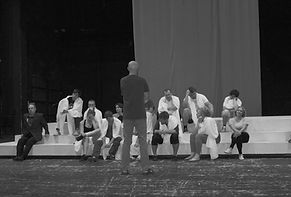


Inside the Studio


_edited.jpg)


Stories from Our Students
Mike Savuica, Romania
Director & Choreographer | Graduate of NIPAI Advanced Professional Program in Theatre Directing
“All the programme modules helped me build this performance. I always had support and a team of people to guide me. The Theatre Directing Programme was the necessary foundation I needed to make my first steps towards a directing career. NIPAI taught me to paint with bodies and actors to create tableaus on stage.”

Cody Ganger, USA
Director & College Theatre Professor | Graduate of NIPAI Advanced Professional Program in Theatre Directing
“I credit NIPAI for teaching me how to be truly prepared before starting rehearsals, with strong script analyses, paper blocking, and storyboarding. With this new confidence and skill set, I’ve only become more ambitious in my choices of shows and my approaches to the shows I do.”

Tuition and Investment
The Theatre Directing Certificate Programme is a 12-month professional commitment with individual mentorship, weekly feedback, and a concrete working output - your Director’s Book.
Programme Fee: €12,000
-
Instalment plans are available once you are admitted.
-
Partial financial support of up to €3,000 is available for qualified candidates, combining need-based assistance and talent-based awards on a competitive basis.
This covers 12 months of structured training, individual mentor feedback on every assignment, access to both distance and blended formats, and all programme materials. Upon admission, a €1,200 registration deposit is required to secure your place in the programme. This amount is included in the total programme fee of €12,000 and is credited toward your tuition.
The registration deposit is non-refundable. If you are unable to start as planned, you may request to apply the deposit as credit toward another NIPAI distance or in-class programme within 12 months, subject to NIPAI approval and availability. Your start date may also be deferred by agreement when NIPAI is informed in advance.
For context: Residential MFA Directing programmes in the US typically cost $60,000–$200,000 over 2–3 years and require relocation. Short workshops (1–10 days) offer introduction but not sustained methodology. This programme was designed for the space in between - serious training that works with your life, not against it.
Questions About Starting Your First Steps in Directing
Here are answers to some of the questions we receive most often from prospective Theatre Directing Certificate candidates.
What background do I need to apply? The program is designed for beginners in directing. You are welcome to apply if you have a serious engagement with theatre practice - as an actor, performer, teacher, stage manager, or theatre-maker - and you are ready for independent written and practical work. Formal directing training is helpful but the program starts with fundamentals and builds progressively.
How does the Distance format work? You study through weekly assignments, written submissions, and individual mentor feedback. Each task develops one part of your Director’s Book. Your mentor reviews your work and provides written commentary, creating a cycle of task - submission - feedback - revision throughout the year.
What is the Blended format? The blended option includes the same 12-month distance structure plus two intensive in-class sessions in Germany or Austria. These sessions allow you to work with space, actors, and peers in a studio setting.
How much time should I plan each week? The program workload is approximately 500 hours across 12 months - around 9–10 hours per week, depending on your pace and project.
When can I start? There are typically two intakes per year, in spring and autumn. Exact dates are confirmed with admitted candidates.
What is the certificate status? This is a professional certificate issued by NIPAI - New International Performing Arts Institute, Berlin. It documents assessed work, learning hours, and completion of the program. It is issued by an independent international performing arts institute and is not a state university degree.
Need more details? View full FAQ ↗
From Our Blog: Resources for Aspiring Directors
Continue your research with NIPAI articles on rehearsal process, Director’s Book, blocking, mise-en-scène, and directing methodology.


